Our Listing: Featured in The Oregonian
An influential architect grew up in this Portland Queen Anne for sale at $600K
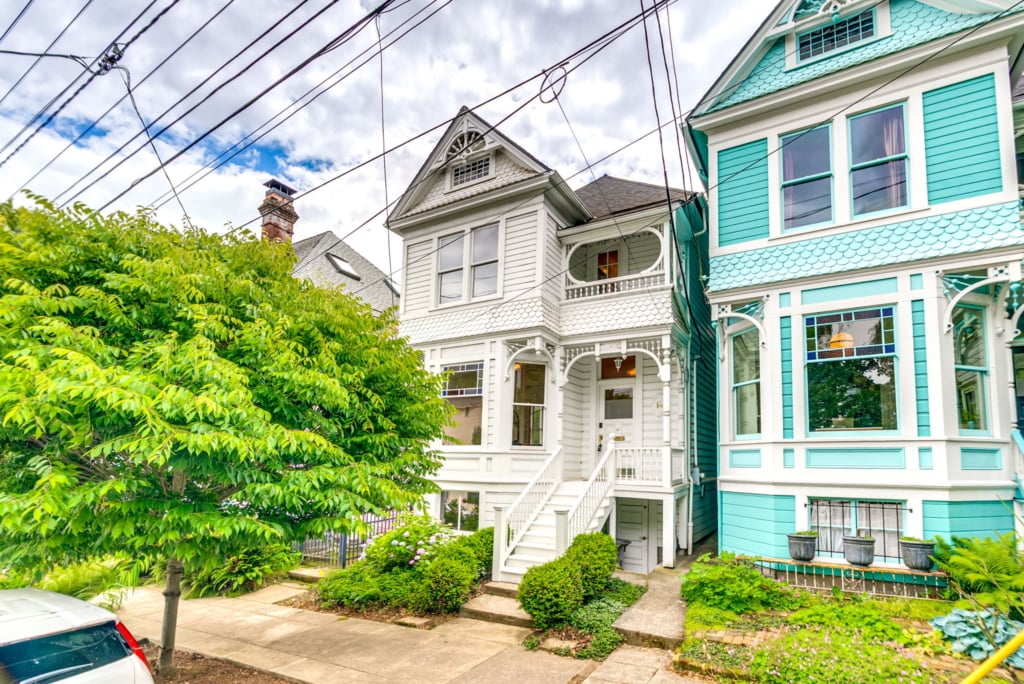
Broker Claire Paris believes the next owner of an updated 1892 Queen Anne house in South Portland’s oldest community will understand how the city became what it is today. (More photos here.)
“This home has had a front-row seat to Portland evolving and reinventing itself, and the buyer who belongs here is going to feel a deep connection to that history,” said Paris of Paris Group Realty.
The two-story, wood-frame house at 14 S.W. Whitaker St. is in the historic Lair Hill neighborhood. The asking price for the 0.03-acre property is $600,000.
The main level of the 2,055-square-foot house features formal living and dining rooms, a large kitchen, a powder room and back deck. Large windows fill the home with natural light and walls with decorative molding rise to 10-foot ceilings.
Original wood window frames hold wavy glass and six-panel wood interior doors have solid brass, vine-patterned hinges and brass doorknobs.
The second story has three bedrooms, a bathroom and a balcony. The full basement with laundry facilities and storage can be finished to create rooms, Paris said.
Recent updates include a new electrical system, furnace and water heater, as well as new lighting and kitchen appliances. The renovations preserved original Douglas fir floors, stained glass and push-button light switches.
“When you look at this house, you aren’t just looking at gorgeous original craftsmanship,” Paris told The Oregonian/OregonLive. “You’re seeing the literal roots of Portland’s architectural identity.”
The house is listed in the National Register of Historic Places as the childhood home of Edward Thomas Foulkes, the architect who designed the 1914 Pittock Mansion in Northwest Portland.
The 16,000-square-foot French Renaissance Revival-style mansion is open to the public daily as managed by Portland Parks and Recreation.
Foulkes, who was born in Oregon in 1874, was responsible for creating stellar city landmarks, exposition pavilions, hotels, banks and grand residences over his long career.
“I just love the image of this kid running around these rooms, and then growing up to design one of our city’s most iconic landmarks,” said Paris. “That sense of history does something to you when you walk through the door.”
She said the next owner may see themselves as stewards of history, but they definitely won’t feel as if they are living in a museum.
“The new owner may be looking to protect a small but meaningful piece of our city’s past while living out a vibrant new chapter of their own,” she said.
Lair Hill neighborhood
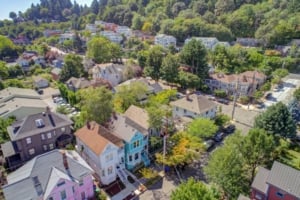
The pink Robert Foulkes house, left bottom corner, is next to The Laura Foulkes House #1 and the Laura Foulkes House #2 on Southwest Whitaker Street. Premiere Property Group
The house sits in a neighborhood with its own remarkable history.
The Lair Hill area of South Portland was a prime investment area in the late 1800s, as immigrants poured into the area from Southern and Eastern Europe.
Lair Hill was named after William Lair Hill, an attorney, historian and editor of The Oregonian who briefly owned property in the area.
Over time, the old railroad line morphed into Southwest Barbur Boulevard and the sweeping Ross Island Bridge ramp consumed a large swath of land.
The Lair Hill neighborhood, at the base of Marquam Hill south of downtown, is near Oregon Health and Science University’s Marquam Hill campus, the Gibbs Street Foot Bridge and the South Waterfront neighborhood.
Portland architectural historian Eric Wheeler compares Lair Hill to New York’s Greenwich Village. “It’s serendipity [Lair Hill] was saved,” he said. ”It was slated for demolition.”
When bulldozers were plowing down buildings for mid-20th century urban renewal projects, neighbors took a stand and made the city redirect its ambitions.
The residents preserved not only their homes, stores and a settlement house, but the stories of the newcomers, said Wheeler.
He said people crossed an ocean to join the city’s prosperity during an economic boom in the late 1800s and after the 1905 Lewis and Clark Centennial Exposition.